

Notes from Game Access 2026
The evening before the event, at a warm-up gathering in the foyer of the exhibition hall, I met a young game developer in her mid-twenties, GenZ. She wanted to combine her hobby (botany, flowers, the organic shapes of growing things) with game design. She had ideas, a portfolio, exactly the cross-disciplinary profile that every conference keynote now demands. What she did not have was a job offer looking for this profile. She was thinking about starting her own studio, but without capital the thought stayed exactly where it was: a thought. She was not bitter. She described her situation with remarkable precision, which only made it worse.
On the way home, in the tram, I fell into conversation with a former project lead from the games industry. Still early in his career but experienced in shipping. He had run agile development teams under crunch, delivered titles, and coordinated across departments. He now works in enterprise software development. He described the switch the way someone describes moving out of a flood zone: not dramatic, just rational. The pay was better, the risk lower, and the hours more predictable. He was not planning to come back.
The two never met. But together, from opposite ends of the career pipeline, they illustrated the same structural problem. The games industry is losing people at the entry point and at the experience level. The people who stay are working harder to listen to their players. And the tools that might help with all of it mostly exist as sketches.
Game Access has been running in Brno since 2016. What started as a gathering of around 400 developers has grown into a two-day conference of over 2,000 attendees: studios, indie teams, students, speakers from Remedy, Bohemia Interactive, MADFINGER Games, Warhorse Studios, and others. Brno, with its 40-plus game studios and the infrastructure of Bohemia Interactive and Warhorse on its doorstep, is a credible host. The conference is well organized, the talks are substantive, and the networking events carry the energy of people who genuinely enjoy what they do.
But Game Access 2026 was also, without meaning to be, a snapshot of an industry stuck at three points simultaneously. Not in crisis. Not collapsing. Stuck: unable to move smoothly through its own transitions.
The pipeline breaks at both ends
Valeria Rossi, Talent Acquisition Lead at Remedy Entertainment, presented what she called "The New Bar." Her talk traced the industry's trajectory from 2020 to 2026 in five phases: the pandemic-driven boom (2020-21), the turn as interest rates rose and spending normalised (2021-22), the correction with mass layoffs beginning at around 8,500 in 2022 (2022-24), a cautious recalibration in 2025, and what she framed as a "new normal" in 2026: studios actively integrating AI into their production pipelines.
The numbers behind that trajectory are not abstract. Roughly 9,200 people were laid off across the industry in 2025, down from a peak of approximately 14,600 in 2024; the count varies between trackers because not all layoffs become public (Matthew Ball / Epyllion; GamesBeat, April 2026). By mid-2025, Europe accounted for 22% of global open game industry roles, with only 10% of those roles being remote (Matthew Ball / Epyllion, State of Video Gaming 2026). Twenty-eight percent of respondents in the GDC industry report said they had been laid off in the past two years; among US developers, the figure rose to one in three (2026 State of the Game Industry, n > 2,300). Forty-four percent of professionals were considering leaving the industry because of redundancies (Skillsearch 2026 Games & Immersive Report, n > 1,000). Thirteen percent had already done so (Values Value / InGame Job 2025, n = 1,650).
And then the bottom end. Rossi showed a slide titled "The Junior Gap." Thirty-nine percent of junior-level professionals left the industry in 2024-2025 (InGame Job 2025). Seventy-four percent of surveyed students expressed concern about their job prospects: too few entry-level positions, competition from laid-off experienced workers, and displacement by AI tools (GDC 2026; the student sample is small at n = 50, but the trend is consistent with the broader data). And the underrepresentation extends to who gets surveyed in the first place: in the Skillsearch 2026 report, only 4% of respondents identified as junior level and 1% as graduate. That is a structural visibility gap as much as a hiring gap.
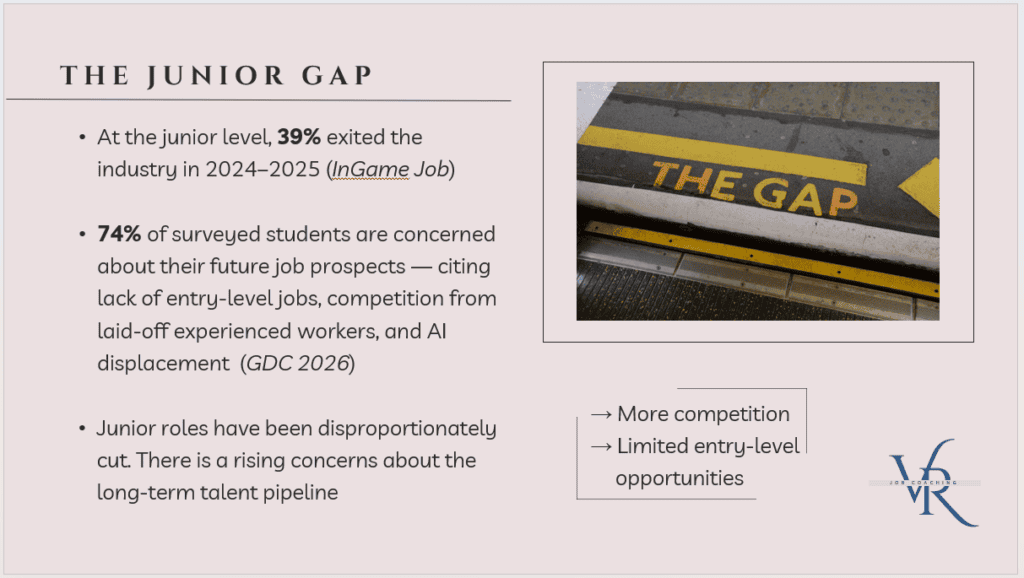
The bar, as Rossi put it, has not simply gone up. It has changed shape. Studios now prioritise portfolios and shipped work over degrees. They want T‑shaped profiles: one deep specialism plus cross-discipline awareness. They want low onboarding costs. They want adaptability, because teams are smaller, remits are broader, and production pipelines are changing. Soft skills (communication, documentation, proactivity) are no longer a nice-to-have appendix on a CV. They are selection criteria.
This is a coherent response from the hiring side. It is also, structurally, a response that favours experienced mid-level candidates and raises the entry barrier for juniors. If the industry wants portfolios with shipped work, it needs shipped work available for juniors to contribute to. If it wants T‑shaped profiles, it needs entry points where those profiles can develop. What Rossi's data describes is a system that has recalibrated its expectations without recalibrating its entry mechanisms. The new bar is clear. The ladder to reach it is not.
The Central and Eastern European market offers a partial counterweight.
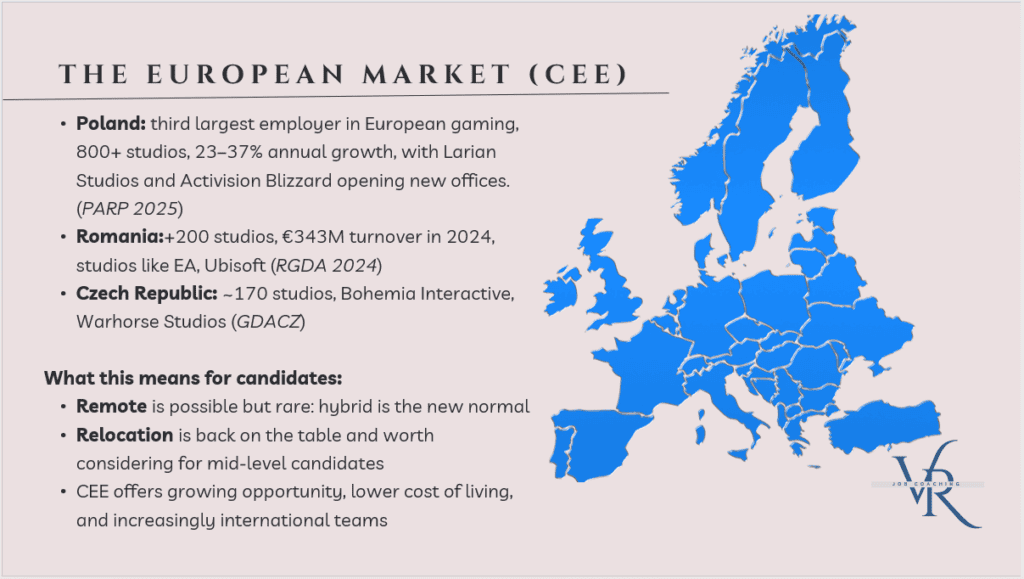
- Poland is the third-largest gaming employer in Europe, trailing only the UK and France, with over 800 studios and 14,568 specialists; Larian Studios and Activision Blizzard have opened new offices there (PARP / EGDF 2025).
- Romania has 206 active studios and 6,700 employees, with €343 million in turnover in 2024; Bucharest is the primary hub, Cluj-Napoca and Timișoara are emerging secondary hubs (RGDA 2024).
- The Czech Republic, Game Access's home market, has roughly 170 studios including Bohemia Interactive, Warhorse Studios, and SCS Software; 95% of the country's gaming revenues come from international sales (GDACZ).
Remote work is possible but rare; hybrid is the standard. Relocation is back on the table, particularly for mid-level candidates. Central and Eastern Europe is growing. But under conditions that assume mobility, adaptability, and a willingness to relocate for work that may not be permanent.
Back to Brno: the young developer with the botany portfolio in the foyer had exactly the T‑shaped profile Rossi described. One deep specialism, a creative cross-connection, genuine curiosity. The job that matches it does not exist yet.
The project lead in the tram, meanwhile, had left a system that no longer offered him a rational reason to stay. He is one of the thirteen percent. Between the two of them, the gap opens up.
Game Access 2026: The industry listens, but in the wrong rhythm
On the second day, Niles George, Senior Community Manager at Bohemia Interactive, gave a talk on community communication that turned out to be one of the most analytically interesting sessions of the conference.
George works on the Arma team at the studio that also develops DayZ. Both games have communities that are vocal, invested, and occasionally hostile. His experience has given him a perspective that many community management talks lack: he does not treat player anger as a problem to be managed. He treats it as information to be translated.
The core of his argument was a framework he called "Translation." On one slide, he placed five typical player statements next to what, in his experience, they actually mean. When players call the development team lazy, they are usually expressing frustration about timelines or design decisions they cannot follow. When they say nobody asked for a feature the developers just built, what they mean, translated, is that they cannot see how it fits their way of playing. When they say the studio never listens, they lack visible evidence that their feedback changed anything. When they say an update ruined the game, something in their routine, their expectations, or a reference point they relied on has been disrupted. And the loudest, angriest version of all these statements often comes down to the same thing: a blocked enjoyment.
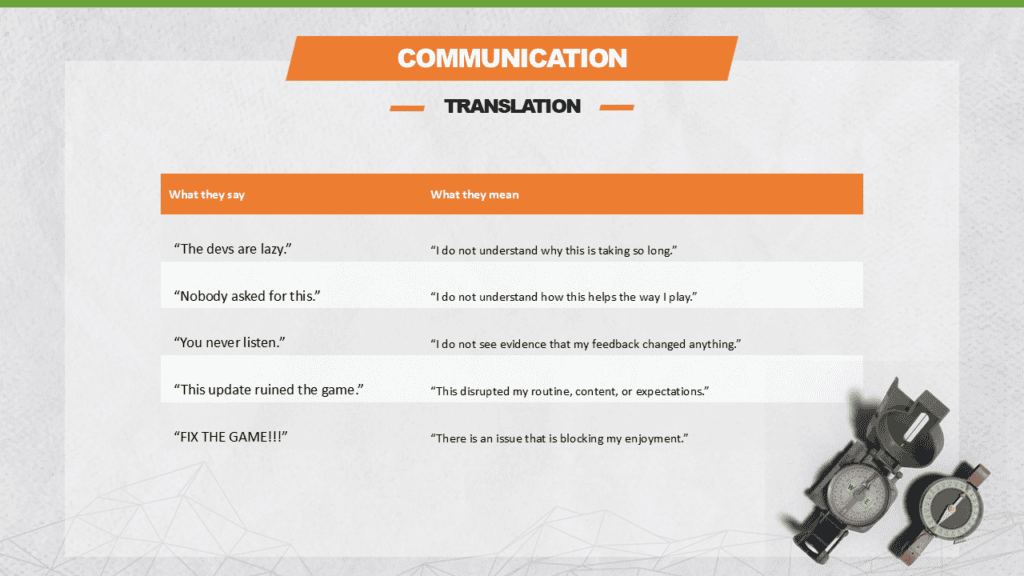
This is a simple idea, but it has depth. George is not saying that all angry players are right. He is saying that anger is encoded communication. And that a community manager who responds to the surface statement without translating it will escalate rather than resolve. The parallel to moderation and facilitation practice is striking: any experienced group facilitator knows that the person shouting loudest in a meeting is rarely shouting about what they claim to be shouting about.
George extended this with a second observation that deserves attention. He pointed out that strong emotion from players usually signals investment, not malice. And he offered a sentence about the vocal minority that was more honest than the industry's usual framing: not every loud voice represents the majority, but not every loud voice is wrong. That distinction matters. The standard industry response treats vocal critics as outliers to be weathered. George suggests they might also be data points to be read.
He also made a point about the spaces between announcements. Announcements of major updates, new features, or DLCs generate attention. Connection, George argued, is built in the quieter phases between them: the reactions on small patch notes, the community threads, the responses that arrive when nobody is watching. Trust is built in small moments before the big moments test it.
Two further observations from the conference reinforced the pattern George described, from different angles.
Jakub Vamberský, Communications Lead at MADFINGER Games, presented Gray Zone Warfare's approach to community communication. MADFINGER actively mirrors back what they hear: when the community criticizes a feature, the studio communicates the response, "You raised concerns about Feature X. You can now turn it off in the settings." They stream updates, invite content creators to releases, and produce short-form content. This is better than silence, and it builds trust. But it operates in the same rhythm as most of the industry: post hoc, between patches, in response to aggregated feedback.
At Warhorse Studios, the developers of Kingdom Come: Deliverance (KCD), a similar pattern emerged from a different angle. Between the first and second installments, the studio implemented significant changes based on community feedback: the sword combat became more accessible, and the save system was simplified (the first game launched without a straightforward option to save and quit). These were real improvements, responsive to real complaints. But the difficulty level in both games (haradcore or normal) is set once at the beginning, written to the database, and cannot be adjusted during play. This is a conscious design choice, and Warhorse is clear about it: they want a difficulty that players work against, not one that adapts to avoid friction. A defensible position. At the same time, from a design perspective, an example of a system without a situational adjustment mechanism.
What connects these cases is not that any of them does community work badly. George's "Translation framework" is nuanced. MADFINGER's communication loop is more responsive than what most studios manage. Warhorse's willingness to learn from community feedback is genuine.
And there is a fourth layer that goes beyond community communication. A panel brought together UX researchers from CD Projekt Red, Pixel Federation, and freelance research, with experience at studios including SEGA and Creative Assembly. They discussed the role of player feedback in game development. What they described is methodologically serious: dedicated research teams that work independently from the development team to minimize bias. Playtests with participants who are deliberately selected, sometimes with the requirement that they were not involved in the last round of research, so that familiarity with the material does not distort the results. Behavioral observation, analytics, metric evaluation. This is not tea-leaf reading from forum threads. It is research with methodological rigor.
But this research, too, is asynchronous. It takes place before a release, between updates, in controlled settings outside the live game. What UX researchers measure is the behavior of test players in an observed situation, not the behavior of a player who is stuck alone at eleven at night, weighing whether to quit. The insights feed into the next version, the next patch, the next design decision. They do not feed back into the moment where the frustration occurs.
The pattern becomes more complete. The industry has developed three feedback modes, all of which work in their own way:
- Community communication.
- Iterative design between releases.
- Methodical player research before and after launch and updates.
All three are retrospective, or at least asynchronous.
What none of them do: recognize, in the moment of play, that someone is stuck, frustrated, or about to quit, and respond before the damage is done.
This observation was not part of any talk at Game Access. Nobody framed it as a gap. It sat in the space between the sessions, visible only if you were looking for it.
The tools exist as ideas, not as practice
There were moments during the conference when the outline of a different approach became briefly visible.
In a conversation at the stand, Vamberský showed me the Field Handbook in Gray Zone Warfare: an in-game reference that players can consult when they do not know how to proceed. From personal experience with the game: the handbook exists, but its usability is limited. Finding out how to climb over a particular wall required trial and error: search for "Climb," search for "Vault," and search for "Movement" in the manual. A context-aware AI agent would have answered the question in seconds.
And if even the Handbook does not help? Vamberský pointed to "the most important key" for people who get stuck: the Z key, push-to-talk. It drops you into the server's voice chat, and Gray Zone Warfare has a community that takes newcomers by the hand. The workaround for a missing situational help system is to ask a human. It works, as long as someone is online who answers.

At the Bohemia Interactive stand, a separate team demonstrated their Learning Suite, a sandbox environment where schools use Bohemia's software to teach programming and build educational games. One school had run its entire onboarding process through it. The team mentioned that a knowledge-based AI assistant was planned, one that could answer questions about the development environment when users get stuck. Conceptually interesting, but likely aimed at creators (people building learning experiences), not at end users (people going through them). An AI help system for a programming tool, not for a game.
This is comparable to Unity. Unity's AI tools have gone through a visible evolution over the past three years: from Muse (a generative layer for code, textures, and documentation search, launched in 2023) to Unity AI (an editor-integrated assistant in open beta since 2025, with project-aware context access). The current assistant can reference GameObjects, materials, and scripts. A developer can attach an asset and ask why an object falls through the floor, and the system responds with reference to the specific project. By several accounts, it is a competent development workflow tool.
What it is not, and what Unity has shown no public intention of building, is a player-facing system. Unity AI helps developers understand their tools. It does not help players understand their games. The infrastructure that makes contextual assistance possible (project context, scene awareness, asset references, agentic tool calls) is being built for the production side.
Console and platform holders have started to fill this space from a different direction. Xbox launched Gaming Copilot in March 2025 and rolled it out to PC and mobile by September. PlayStation has offered Game Help since 2020, extended by Community Game Help in 2024. NVIDIA's G‑Assist provides game-related guidance as a side feature. But each of these systems operates as an overlay that reads the screen, not the game. They interpret what is currently visible, but they cannot query the inventory, the active quest, or the missing crafting ingredient when those things are not on screen. The deepest integration with the game state sits with the engine providers, and they are building exclusively for developers. Nobody, at Unity, Unreal, or among the platform holders, has announced a framework that would let studios expose game state to a player-facing assistant in the moment of play
The structural parallel is hard to miss. "I don't understand this development tool" and "I don't understand this game" are, from the perspective of assistance design, closely related problems. Both involve a user blocked by a system whose rules are not transparent enough or not well enough explained. Both benefit from contextual help that meets the user where they are, rather than sending them to a manual. The solution architecture exists for one of these problems. For the other, it is still a research question.
What the Game Access 2026 conference showed without saying it
Game Access 2026 was a very good conference. The talks had substance, the networking worked, and Brno continues to prove that a city with 170 studios can hold its own as a game development hub in the center of Europe.
But what stayed with me was not a session or a slide. It was the shape of a pattern that became visible across two days: an industry that is recalibrating its talent pipeline without fixing its entry mechanisms, that has learned to listen to players, but only retrospectively, and that is building contextual AI assistance for developers while sending players to alt-tab to a wiki or YouTube.
These are not failures. They are transition problems. The kind that emerge when a system is sophisticated enough to recognize what is changing but has not yet built the mechanisms to move through the change. A market that needs juniors but has set the bar beyond their reach. A feedback culture that translates anger, but only after the fact. Tools that could help in the moment of play but point in the wrong direction.
The young developer with the botany portfolio is still looking. The former project lead is not coming back. Somewhere between the two of them, a player is stuck in a survival game at eleven at night, weighing whether to open a guide and have the solution spoiled or to quit and never return. The system has no good answer for any of them.
That is what Game Access 2026 showed, without anyone on stage quite saying it. The industry is not in crisis. It is in transition. And it does not have a good mechanism for its own transitions. Not yet.
Sources:
- Matthew Ball / Epyllion: State of Video Gaming 2026. Layoff figures 2022-2025: approximately 9,200 in 2025, 14,600 in 2024, 44,000 cumulative over four years. Additionally: Europe accounts for 22% of global open game industry roles by mid-2025; only 10% of open roles are remote. Source: GamesBeat interview, April 2026, plus Epyllion 2026 report.
- 2026 State of the Game Industry (GDC, January 2026, n > 2,300): 28% of respondents laid off in the past two years, 33% among US developers, 74% of surveyed students concerned about future job prospects (citing lack of entry-level jobs, competition from laid-off experienced workers, and AI displacement). Freely available at gdconf.com.
- Skillsearch 2026 Games & Immersive Salary & Satisfaction Report (April 2026, n > 1,000): 44% of respondents have considered leaving the industry due to redundancies. Only 4% of respondents were Junior level and 1% Graduate, an underrepresentation that itself indicates a structural visibility gap for entry-level talent. AI adoption is referenced as "more than half of respondents using AI tools."
- Values Value / InGame Job: Big Games Industry Employment Survey 2025 (December 2025, n = 1,650, European focus): 13% have left the industry entirely, 39% of junior-level professionals exited in 2024-2025, 15% have been job hunting for over a year, 27.7% accepted worse terms in a new role.
- PARP / EGDF 2025: The Game Industry of Poland Report (December 2025): Poland is the third-largest gaming employer in Europe, trailing only the UK and France. 800+ studios, 14,568 specialists. Larian Studios and Activision Blizzard have opened new offices in Poland.
- RGDA: Romania Game Developers Association Industry Report 2024: 206 active studios, €343 million turnover in 2024, 6,700 people employed. Largest employers: EA and Ubisoft. Bucharest is the primary hub; Cluj-Napoca and Timișoara emerging as secondary hubs.
- GDACZ: Czech Game Developers Association: ~170 active studios (105 registered companies and 30 freelancer teams). Key names include Bohemia Interactive, Warhorse Studios, and SCS Software. 95% of revenues come from international sales.