

Reported field note, Latitude59, Tallinn, May 2026
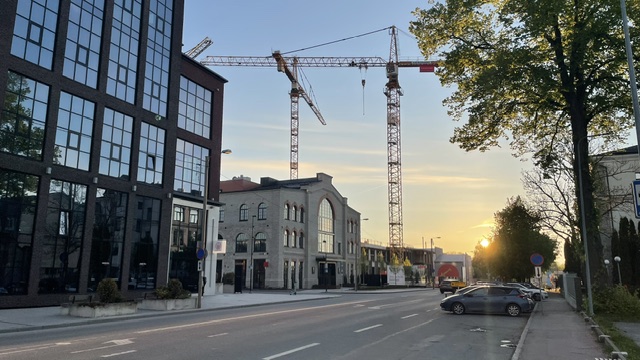
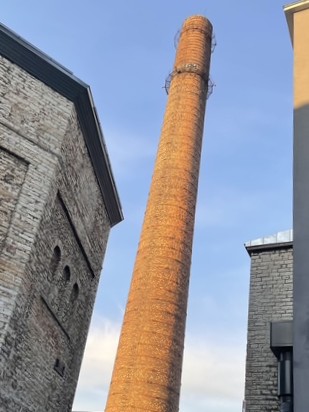
Latitude59, the Baltic region's main startup and tech conference, gathers inside Kultuurikatel, Tallinn's old city power station. Limestone walls, a tall brick chimney rising past the surrounding roofs and holding the last light long after the courtyard below has gone into shadow. The building used to burn coal to heat a city. It cannot be anywhere else. It was poured into this ground, and it stays.
This year's edition called itself "The Global Village Experiment", a phrase built for a world more connected and more fragmented at once. The main programme runs over two days, with a warm-up day before it. I came as accredited press. The thing that stayed with me, though, was not on a stage.
It was the light.
I picked up my badge the evening before the opening, and walking back I kept checking the sky because it would not commit to night. In Tallinn in late May the sun goes down close to ten, and the dusk holds for a long while after that. I do not get this at home; Germany does not stretch the evening in quite this way. A small thing, easy to dismiss, except that it was the first moment Estonia stopped being an interface and became a place where my body actually was. Until then Estonia had been an idea I found persuasive, a country I knew as an argument before I knew it as a place.
That gap, between Estonia as interface and Estonia as place, turned out to be the whole subject.
The promise
e‑Residency is built to make place less necessary. You can run an Estonian company without ever standing in that courtyard.
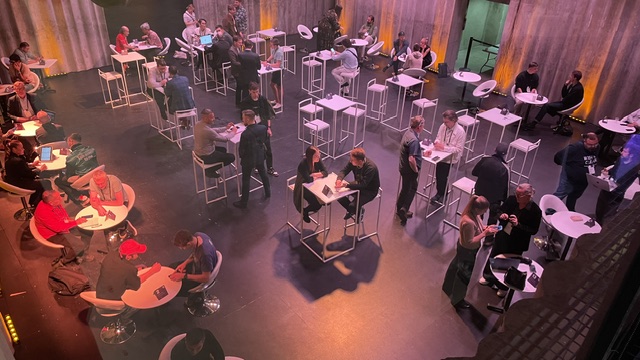
Manuel Schütte, who founded GroüHub and has been an e‑resident since 2018, walked me through it at one of the conference meeting points: a hall of numbered standing tables that the event app lets you book for a scheduled conversation, so a contact and a place to talk arrive together.
His company sets up firms and handles the back office for e‑residents, so he sees the funnel from the inside. The bureaucracy is largely digital. A company can be registered quickly, sometimes within a day or two. A minimum viable product can help support a startup visa application. Enterprise Estonia, the state's business-development agency, he described as a real help rather than a logo on a wall.
The scale is no longer small. Since the programme launched in 2014, more than 135,000 people from over 180 countries have become e‑residents, and they founded a record 5,556 Estonian companies in 2025 alone. Germany is one of the larger source markets; Schütte put the German contingent at roughly 4,000, and the official figures bear out the direction, with Germany the single largest source of new applications in 2025.
The entry cost is modest and one-off: a state fee of 150 euros, a digital ID valid for five years, no monthly subscription for the e‑resident status itself.
The impressive part is not hard to see. What interests me is what the smoothness hides.
Belonging as a subscription
On a panel at Day 0 in the evening, in the conference's press-dinner programme, Kaspar Korjus made the point that has stayed with me since. Korjus ran e‑Residency in its early years and now co-founds Pactum, a company building AI for contract negotiation.
His own framing was that the country could be run a little like Netflix: a service e‑Residents subscribe to, generating steady monthly revenue from a base that pays in month after month. He meant it admiringly, as a model worth scaling.
The logic is hard to argue with once you see the numbers behind it. Estonia is shrinking.
- On the first day of 2026 it had 1,360,745 residents, about 9,250 fewer than a year earlier.
- More people died than were born,
- and for the first time in over a decade more people left the country than moved to it.
A country in that position needs forms of inflow it cannot generate through births alone: people if it can get them, economic participation if it cannot. e‑Residency is one answer: not citizens, not necessarily immigrants, but a standing base of people who attach themselves to the country's infrastructure and contribute to it from a distance. The programme's measured economic effect in 2025 ran to roughly 125 million euros, counted through labour taxes, dividend-related taxes, and state fees.
As economics, Korjus has a point. The literal mechanics do not fully match the metaphor; there is no monthly bill simply for being an e‑resident. But the metaphor is doing the real work. A subscriber has access, not a home. The relationship is genuine and also conditional: renewable, service-based, cancellable.
If a country starts to close part of its demographic and economic gap by treating belonging the way a service treats its subscriber base, what kind of belonging is that?
The question is not an accusation. It is just what the word opens up once you take it seriously.
The layer you arrive in
Here is the part nobody put on a slide, and it is mine to observe rather than anyone's to quote.
Arriving in a system depends on which layer you arrive in.
- The outer layer, registration, is deliberately frictionless.
- The inner layer, actually earning a living in a place and being taxed for it, is where the resistance lives.
The strange thing is that you can hit the resistance whether you move or not.
Take my own case, someone in Germany who does not move. You keep living there and run an Estonian OÜ, the Estonian equivalent of a private limited company, from your desk at home. The Estonian headline is famous: an OÜ pays no corporate tax on retained or reinvested profit, taxation falls due only when profits are distributed. But the place where you actually run the company matters more than the place where you registered it. If the work happens at a German desk, German tax law can treat that desk as a permanent establishment of the company, and the profits earned through it become taxable in Germany. The treaty between the two countries then steps in to keep the same profit from being taxed twice, not to hand the income back to Estonia.
This is not a hostile reading of the programme. It is what e‑Residency's own guidance says: incorporating in Estonia does not by itself free a company from tax obligations where it is actually run, and an e‑resident living and working in, say, Frankfurt may have to register a permanent establishment in Germany and pay German tax on the profits. Tax follows substance, where the decisions are made and the work is done, not the address on the registration. GroüHub, for what it is worth, has that substance: most of the team is in Estonia, the company was built there. That is exactly what keeps the tax logic intact.
Moving does not dissolve the friction, it relocates it. Relocating to Estonia shifts your personal tax residency, but the year of the move is its own tangle: for a while two systems can each have a claim on you, and untangling which one yields takes paperwork, timing, and usually advice.
I am not a tax adviser, and this note is not tax advice. Anyone weighing this should check the current rules with the tax authorities of their own country and of Estonia, and ideally with a professional, before relying on any of it. The point here is structural, not procedural.
The cheap part is starting. The expensive part is being somewhere.
The helper who moved on
Which brings me back to Manuel Schütte, and to the detail that reframes the conversation.
Schütte did make the physical crossing. He lived in Estonia as a permanent resident for three years before relocating to Barcelona in 2022. He knows what he is describing from the inside: he built GroüHub in Estonia, most of the team is still there, and he chose to continue running the company remotely after he left.
That is not a contradiction of the model. It is the model, applied to someone who tried both sides and decided which one fit. Which makes the two questions I never got answered harder to dismiss.
- What does a failed soft landing look like?
- And how does someone cross from digital nomad passing through to integrated member?
Schütte made the crossing, stayed three years, and then left. He is the only person I spoke to who could answer those questions from both sides. Whether what he built and left behind counts as having arrived, I did not think to ask. That is the follow-up.
The ones who move in person
Late at the afterglow party, two journalists gave me the counter-test. Their version of the story confirmed the easy half: forming a company from abroad can be quick. Then they listed what waits for people who physically relocate.
- Taxation pulling from more than one country at once.
- A work visa, in the worst case, for non-EU citizens.
- Wages that may not match what you left.
In their telling, the administrative welcome is warm; the economic one can be colder.
One of them said something offhand that has stayed with me.
"Estonians are cosy people."
It was not a complaint. It was almost affectionate. But it was meant as a warning as much as a description. Estonians keep to themselves, the way the Nordic temperament tends to.
And the arriving foreigner sometimes has to do the un-Nordic thing to break in. Move into an apartment building, I was told, and the move that works is the one that feels rude: knock on the doors, introduce yourself, make everyone slightly uncomfortable for a minute. After that they know you, you know them, and the nods on the staircase start to make sense. Belonging here is not handed over. Maybe you sometimes have to be a little pushy to earn the right to be greeted.
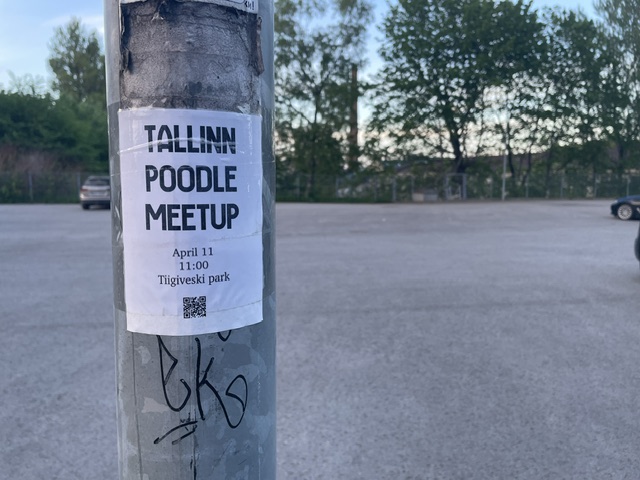
Or maybe there is a more Estonian way around it. On lampposts and at traffic lights around the city I kept seeing the same handmade sign: "Poodle meetup", and a QR code. People with poodles, arranging by code to bring their dogs to the same patch of grass. An Estonian I mentioned it to thought it fit the country exactly: digital first, even here. You sort it out through the digital code, the dogs do the sniffing. And by the time the humans actually stand together there is already enough shared ground, one shared affection, that meeting in person feels natural rather than forced. The login still comes first. But here it is laid down as a path toward the body in the same place, not a substitute for it.
Someone else at the conference put the same thing in terms of time. You have not really arrived in Tallinn, they said, until you have spent a winter here and stayed anyway. They did not mostly mean the cold and the snow, though those too. They meant the dark: that the long bright evenings I had just been marvelling at are the summer half of a bargain, and the other half is months when the light barely shows up at all. The login takes a minute. The winter takes a winter.
That is the layer underneath the tax law and the startup rhetoric: the social one, where a system can be wide open at the screen and still slow to make room at the table.
What stays open
I keep coming back to the courtyard and that long, refusing dusk.
A global village experiment, the conference called it. e‑Residency is one of the boldest versions of that experiment anyone has built, and it is very good at the part it was designed for: distance. Other countries are watching Estonia's digital infrastructure and want it for themselves; that much was said plainly that evening. It was not primarily built for arrival, though, and it does not really pretend otherwise.
What surprised me was how rarely the gap surfaced as a problem in the conversations around me.
Maybe it is not one. Maybe a country can strengthen its economy with remote participants, and a brick chimney that catches the evening light is home enough for the few who actually want to stand under it.
But the two questions I came in with are still sitting there, unanswered, and they are the ones that matter.
- What does a failed landing look like?
- And what turns someone passing through into someone who belongs?
The system that got everyone here so easily has, so far, little to say about either.
Reporting notes and sources
Reporting notes are below. The full source list is collapsed. Click to expand if you want to see the working.
This is a reported field note, not a comprehensive report. The conversations took place at Latitude59 in Tallinn in May 2026: a prepared interview with Manuel Schütte at a conference meeting point, a panel talk featuring Kaspar Korjus during the press-dinner programme, and an informal conversation with two journalists at the afterglow party. Three further remarks come from unnamed conference attendees: one on neighbourliness, one on the poodle meetup as an Estonian way of meeting, and one on surviving a Tallinn winter. All are reported as overheard or offhand observations, not as sourced claims. Everyone in the piece is kept anonymous except Schütte and Korjus, who are named because they spoke in a public, professional capacity; the two journalists and the other attendees are not identified.
A correction was made after publication. An earlier version of this piece stated that Schütte had never made the physical crossing to Estonia and that his team was based primarily in Barcelona. Both were incorrect. Schütte lived in Estonia as a permanent resident for three years before relocating to Barcelona in 2022; most of the GroüHub team remains based in Estonia. The text has been updated accordingly. Source: Manuel Schütte, direct message, June 2026.
Sources
Conference and venue. Latitude59 2026 ran 20 to 22 May in Tallinn, with the main programme across 21 and 22 May, under the theme "The Global Village Experiment." Venue: Kultuurikatel, Tallinn's former power station. Source: latitude59.ee, agenda and main-programme pages, accessed May 2026.
GroüHub and Manuel Schütte. GroüHub (grouhub.co) provides company formation and back-office services to e‑residents and is listed on the official e‑Residency marketplace; the company states registration in one to two business days, fully online. Manuel Schütte is its founder and an e‑resident since 2018. He lived in Estonia as a permanent resident for three years, building GroüHub from inside the country, before relocating to Barcelona in 2022 and continuing to run the company remotely. Most of the team remains based in Estonia, with smaller parts in Italy and LATAM. Sources: grouhub.co (company formation and about pages); e‑Residency marketplace provider listing (marketplace.e‑resident.gov.ee); interview, Latitude59, May 2026; Schütte, direct message, June 2026. The "built for e‑residents, by e‑residents" characterisation is the author's own phrasing and is not a GroüHub slogan or a Schütte quote.
Kaspar Korjus. Co-founder of Pactum and former Managing Director of e‑Residency; listed as a panellist in the Latitude59 2026 programme. The Netflix/subscriber framing is his own, from his panel remarks, and is paraphrased rather than quoted verbatim. The separate observation that other countries want Estonia's digital infrastructure is also his, made in reference to the infrastructure itself rather than to the subscription idea. Source: speaker's own statements, Latitude59, May 2026; role confirmed via latitude59.ee speaker listing.
e‑Residency scale and economics. More than 135,000 e‑residents from over 180 countries since the 2014 launch; a record 5,556 companies founded by e‑residents in 2025; Germany the largest single source of new applications in 2025 (1,122, up 49 percent); programme economic effect for 2025 of approximately 124.9 million euros (labour taxes, dividend-related taxes, and state fees). Sources: e‑Residency official dashboard (e‑resident.gov.ee/dashboard, last updated 14 January 2026); programme year-end figures via Invest in Estonia / Baltic VC, 30 January 2026. Schütte's estimate of roughly 4,000 German e‑residents is his own figure from the interview and is reported as such.
Cost of e‑Residency. State fee of 150 euros; digital ID valid five years; no annual or maintenance fee for the status. Source: e‑Residency knowledge base, "Costs & fees" (learn.e‑resident.gov.ee, accessed 2026).
Estonian corporate tax. An Estonian resident company such as an OÜ, and the permanent establishment of a foreign company registered in Estonia, pays 0 percent income tax on retained and reinvested profit; corporate income tax falls due only on distribution, at the 22⁄78 rate on the net amount distributed. This deferral does not extend to a sole proprietor (FIE), who is taxed on business income as earned. The 0 percent rate on retained profit is real but not unconditional. On the 2026 rate: a planned increase to 24 percent, and a separate 2 percent corporate "defence/security" levy floated for 2026 to 2028, were both reported in 2025 and then cancelled by the Riigikogu (decision of 3 December 2025); the rate currently shown by the Estonian Tax and Customs Board (EMTA) for 2026 is 22⁄78. Older secondary sources citing 24 percent or a 2 percent profit tax are out of date. Sources: EMTA, "Tax rates" and "Taxation of dividends" (emta.ee); Invest in Estonia, "Corporate income tax"; PwC Tax Summaries, Estonia; Riigikogu press releases, 18 June and 3 December 2025; 1Office, "Estonian OÜ tax guide 2026."
Where the company is taxed (the text's central tax claim). The friction described in the text is documented, not inferred. Under German law a corporation is subject to German taxation through either its place of effective management (section 10 Abgabenordnung) or a domestic permanent establishment (section 12 AO; Article 5 of the Germany-Estonia treaty names a "place of management" as a permanent establishment). e‑Residency's own cross-border tax guidance states the matching case directly: an e‑resident living and working in Frankfurt may need to register a permanent establishment in Germany, the resulting profits are taxable in Germany, and the Germany-Estonia treaty then serves to prevent the same profits being taxed again in Estonia. The text uses the permanent-establishment path because it is the one the official guidance spells out for exactly this Germany-based situation; full unlimited German corporate-tax liability via place of effective management is a related but heavier alternative not needed here. EMTA confirms the same direction from the Estonian side: a company managed from outside Estonia can become taxable abroad, and e‑Residency is not an exemption from foreign tax obligations. Sources: EMTA, "Tax liabilities of companies established by e‑residents"; e‑Residency, "Cross-border taxes / permanent establishment and dual residence"; sections 10, 11 and 12 AO; Article 5, Germany-Estonia double taxation treaty.
Germany-Estonia double taxation treaty. Used in the text as the author's own country pair, not as a general rule. The treaty allocates taxing rights and provides relief from double taxation (residence and tie-breaker rules in Article 4, permanent establishment in Article 5, relief in Article 23). A treaty does not create a tax claim on its own; it assigns rights where two countries' domestic rules both reach the same income. Sources: Germany-Estonia double taxation treaty, full text via Riigi Teataja; German Federal Ministry of Finance, general guidance on double taxation treaties; 2020 amending protocol via Bundesgesetzblatt.
The relocation case. The move itself can trigger German exit taxation (section 6 Außensteuergesetz) where an individual holds a qualifying stake in a corporation, and personal tax residency turns on actual circumstances (available housing, centre of vital interests, the 183-day test in Estonia), not on deregistration or e‑Residency status. These mechanics are deliberately kept out of the body text and flagged here as the area most dependent on individual facts. Sources: section 6 AStG and the Federal Ministry of Finance application guidance (22 December 2023); sections 1, 8 and 9 of the German Fiscal Code / Income Tax Act; EMTA, "Determining residency."
Estonian demography. On 1 January 2026 the population was 1,360,745 (revised figures published April 2026), a fall of 9,250 on the previous year; 9,240 births and 15,688 deaths in 2025; 15,212 immigrants and 18,014 emigrants, making net migration negative for the first time in over a decade. An earlier preliminary release (14 January 2026) gave 1,362,954 and a decline of 7,041; the revised figures supersede it. Source: Statistics Estonia (stat.ee), "1,360,745 people: Estonia's population declined for the second year in a row," 21 April 2026.