
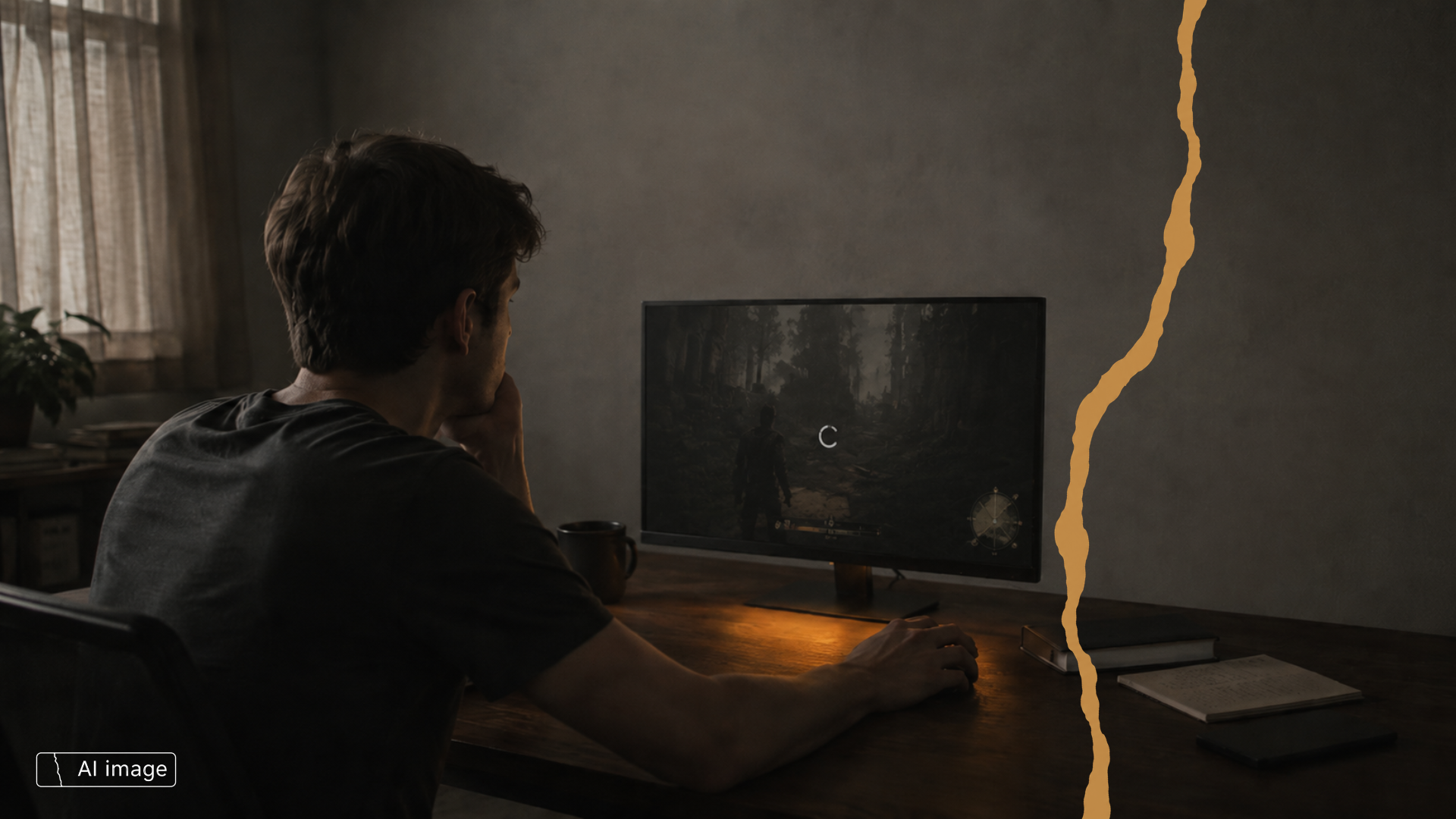
The moment everything stops
You know the moment. You've been playing for two hours, fully absorbed, making decisions, exploring, dying, trying again.
And then you hit a wall.
- A puzzle you can't solve.
- A boss you can't beat.
- A path you can't find.
What happens next is almost universal: you Alt-Tab. You open a second screen. You type into Google. You find a Reddit thread, a YouTube walkthrough, a Discord channel.
And within thirty seconds, you know something you didn't want to know. Not just how to get past the wall, but what's on the other side of the next three walls.
This friction point, the moment a player leaves the game world to seek help, is one of the most underexamined problems in player experience design. It sits at the intersection of frustration, trust, spoiler sensitivity, and the way communities form around games.
As AI-assisted tools become more capable by the month, the design question sharpens: what does it actually mean to help a player without breaking what makes the game worth playing?
Why alt-tabbing matters more than it seems
Context switching has a well-documented cognitive cost [1]. Every time a player leaves a game to search externally, there is an attentional toll: not just the interruption itself, but the effort of re-immersing afterward.
Research on flow states in play [2] describes absorption as dependent on a precise balance between challenge and skill, with clear goals and immediate feedback. Once that balance is disrupted, the conditions for flow must be re-established from scratch. For narrative-driven games, where atmosphere and pacing are deliberate, this matters.
But the disruption isn't only cognitive. It's informational. The web doesn't offer graduated help. A search for "how do I get past the cathedral doors" doesn't return a single clean answer. It returns a cascade of community content written by players at the end of the game, with full knowledge of everything that happens between now and the credits.
Walkthroughs are a paratextual form. Mia Consalvo frames them as part of the broader ecosystem of guides, FAQs, and community texts that surround games [3]. They routinely blend mechanical instruction with plot reference in ways that make separation difficult.
What early survey responses suggest
For the past several weeks, I've been collecting structured and unstructured responses from players, recruitment running mainly through gaming communities, the largest group being survival players reached via Reddit. The current dataset covers round 50 responses. Small, self-selected, skewed toward PC players and frequent gamers, so the figures below are directional rather than representative.
The first phase focuses on help-seeking behavior: how often players seek external help, what they do first when stuck, how they perceive spoiler risk, and what frustrates them about existing guides.
A few patterns stand out.
- Players are more self-reliant than the "alt-tab reflex" stereotype suggests. Roughly two thirds say their first response to being stuck is to keep trying on their own, not searching immediately.
- External help is something most reach for "sometimes" rather than constantly. But when they do search, the context switch is physical: around four in five look for help by alt-tabbing on the same PC or picking up their phone.
- The second pattern is more pointed. A clear majority report having paused or abandoned a game more than once specifically because they got stuck. Getting stuck is not a marginal annoyance; it is a recurring exit point.
- The third pattern concerns guides themselves. The most common complaints are not what I expected: difficulty finding the relevant part of a guide and intrusive advertising lead the list, followed by outdated information.
- Spoilers are a real concern, but a divided one. Roughly half say spoilers in guides bother them, while a third say they do not, which fits the research literature on how widely spoiler tolerance varies.
This is first research. The sample is small and self-selected, and I'm cautious about overgeneralizing. But the directional signal is consistent enough to take seriously: getting stuck pushes a meaningful share of players out of games entirely, the existing help ecosystem frustrates them in concrete and measurable ways, and spoiler sensitivity is real but far from uniform. That combination has design implications.
Why spoilers are not a minor issue
Academic spoiler research has moved well beyond the popular assumption that spoilers ruin experiences. The picture is more nuanced. Empirical work by Leavitt and Christenfeld found that spoiled conditions sometimes produced higher enjoyment ratings than unspoiled ones, particularly for literary and mystery formats [8]. The so-called spoiler paradox [9], the ability to experience suspense even with outcome knowledge [4], is well-documented in narrative psychology.
For interactive media, the calculus is different. Spoilers in games don't just reshape narrative experience; they reshape decision-making. In branching narrative games, knowing an outcome in advance changes the terms under which a choice is made: what feels like a genuine moral dilemma becomes a route-optimisation problem. The sense of agency, what Janet Murray called "the satisfying power to take meaningful action and see the results of our decisions and choices" [5], is diminished not because the choice disappears, but because the uncertainty that made it meaningful has been pre-empted.
This is not an argument for paternalism in help design. Players have different spoiler tolerances, and some actively prefer advance knowledge [6]. The argument is for calibration and control: help systems that let players choose how much they want to know, at what level of narrative depth, and when.
What studios already do, and where gaps remain
Some studios handle this thoughtfully. In‑game hint systems, carefully designed tutorial structures, contextual tooltips: the field's established toolkit. Games like Disco Elysium, Outer Wilds, and the Souls series have all provoked public discussion about how much, or how little, to guide players. The community response to these choices is telling:
- players who feel helped are loyal
- players who feel patronized or inadvertently spoiled feel betrayed.
But the gaps are structural. Official hint systems often don't scale to the breadth of player questions. Community platforms that do scale, wikis, Discord servers, YouTube, are not architected around spoiler sensitivity. And the rise of AI assistants has not yet produced tools that can reliably navigate the difference between a mechanical question and a narrative one, or that apply progressive disclosure principles [7] to in-game help.
Why Game Access is a relevant place for this conversation
In less than a week, developers, designers, tool builders, and indie teams from across Europe will gather in Brno for Game Access '26, the ninth edition of one of the continent's most community-oriented developer conferences. More than eighty speakers, a hundred indie and student teams, and a new Career Hub connecting developers with mentors and recruiters. One of the few events that genuinely spans the full spectrum: narrative design, production workflow, tooling.
Among the speakers is Yuka Kitamura, composer of the Elden Ring, Dark Souls III, and Sekiro soundtracks, a developer whose work exists almost entirely in service of an experience that players are meant to discover for themselves, at their own pace, with as little forewarning as possible. That design philosophy is directly relevant to the questions raised here.
The conference is also a good environment for research conversations. Sessions dense with practitioner knowledge. A networking culture that is deliberately open. And a mix of attendees, indie developers on their first title and veterans from studios like Warhorse, Bohemia Interactive, and Hangar 13, which means that questions about player experience land in very different contexts and produce genuinely varied answers.
Open questions for developers
The questions I'm bringing to Brno are not about AI efficiency or production pipelines. They're more specific.
- When players get stuck in your game, what do you want them to do?
- Have you designed for that moment, or has the community built something in your absence?
- Do you think about spoiler risk when you think about player support, or is that someone else's problem?
- If an AI system could answer player questions in real time, what should it be allowed to say, and what should it refuse?
Design questions. Ethics questions. Trust questions. They don't have consensus answers. That's precisely why they're worth asking at a room full of people who ship games for a living.
An invitation to dialogue
This is the beginning of a research line, not its conclusion. I'll be continuing these conversations toward gamescom/ devcom later in the year, where the scale and diversity of participants shifts the context again. But Game Access is where the conversation starts in 2026: small enough to be genuine, broad enough to be representative.
I will be at Game Access 2026 in Brno and would be very interested in talking to developers, designers, and community managers who think about player frustration, support systems, AI tools, or community trust.
Feel free to find me at the conference or reach out in advance: My Contacts
Sources
[1] Monsell, S. (2003): Task switching. Trends in Cognitive Sciences, 7(3), 134-140.
[2] Csikszentmihalyi, M. (1990): Flow: The Psychology of Optimal Experience. Harper & Row.
[3] Consalvo, M. (2007): Cheating: Gaining Advantage in Videogames. MIT Press.
[4] Gerrig, R.J. (1989): Suspense in the absence of uncertainty. Journal of Memory and Language, 28(6), 633-648.
[5] Murray, J.H. (1997): Hamlet on the Holodeck. The Future of Narrative in Cyberspace. MIT Press.
[6] Gray, J. & Mittell, J. (2007): Speculation on spoilers: Lost fandom, narrative consumption and rethinking textuality. Particip@tions, 4(1).
[7] Nielsen, J. (2006): Progressive Disclosure. Nielsen Norman Group. https://www.nngroup.com/articles/progressive-disclosure/
[8] Leavitt, J.D. & Christenfeld, N.J.S. (2011): Story spoilers don't spoil stories. Psychological Science, 22(9), 1152-1154.
[9] Carroll, N. (1996): The Paradox of Suspense. In: Vorderer, P., Wulff, H.J. & Friedrichsen, M. (Hrsg.): Suspense: Conceptualizations, Theoretical Analyses, and Empirical Explorations. Mahwah, NJ: Lawrence Erlbaum Associates, S. 71-91.