
One day in Tallinn, ahead of Latitude59
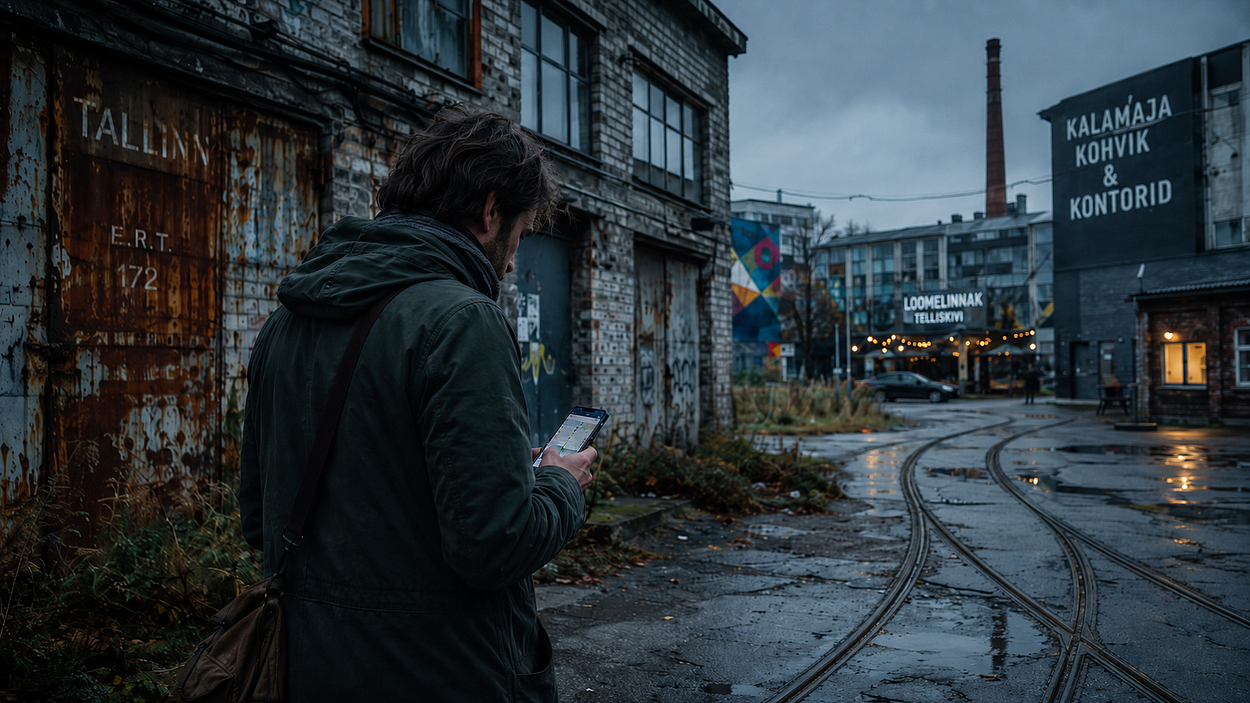
The morning started with a moment of doubt. Google Maps sent me to a parking lot behind a former industrial building, weathered garages, railroad tracks around, overgrown lots, crumbling walls, and no sign I could read. I stood there for a moment thinking, is this right? Is this a scam? Can I trust this address?
Finally all was fine. I was looking for the Palo Alto Club, a coworking space in Tallinn's creative district: a repurposed industrial neighborhood full of studios, workshops, and small companies.
Google had indexed the garage building behind the facility instead of the main entrance. The coworking space was two minutes' walk around the corner. But the mistrust arrived before I had a single data point to justify it. That reflex is fast, physical, preceding any evidence but it is worth noting.
A full disclosure before I go further: Palo Alto Club offered me a free trial day. What follows is my honest observation from that day, not a "paid review.”
An hour later, inside the building, I received an access chip. Good for today, Wednesday, and pre-activated for Friday, the day I'd actually booked. No ID check, no document scan, no form to fill in. The person who showed me around showed me everything in detail: the kitchen, the meeting rooms, the call booths, and the most important piece of technology: the coffee machine. The only data from me: a phone number and an email address. In Estonia, neither requires a national ID card to obtain. That was the entire verification process. A chip for a stranger, valid for two days, on the basis of an email address.
I noticed the wifi password on the wall as she pointed it out and had a brief internal question: do I connect to this directly, or do I want a VPN between me and a shared network in a building I have never been to? A small trust calibration: not distrust exactly, just the habitual caution of someone who works on unfamiliar networks. I connected directly. It was fine. But the question of trust was there.
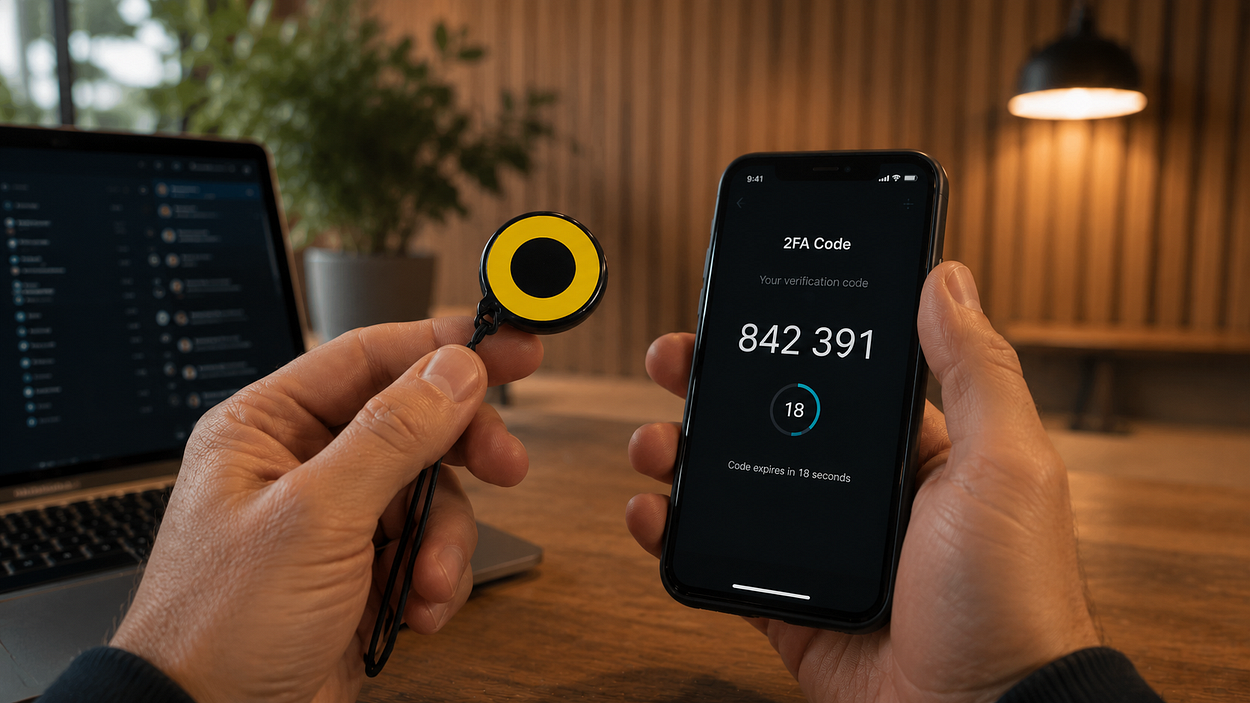
Later that afternoon, same building, same wifi network, same device, fifteen minutes. I joined Slack the first time to get access to the Slack community of the coworking hub.
- First, verify my email address: code to my inbox.
- Then, two-factor authentication to explore my own Slack workspace.
- Then, two-factor authentication again to join the coworking group's channel, with a third code.
Three separate identity checks, on the same connection, in the same room on the same device. This is Slack...
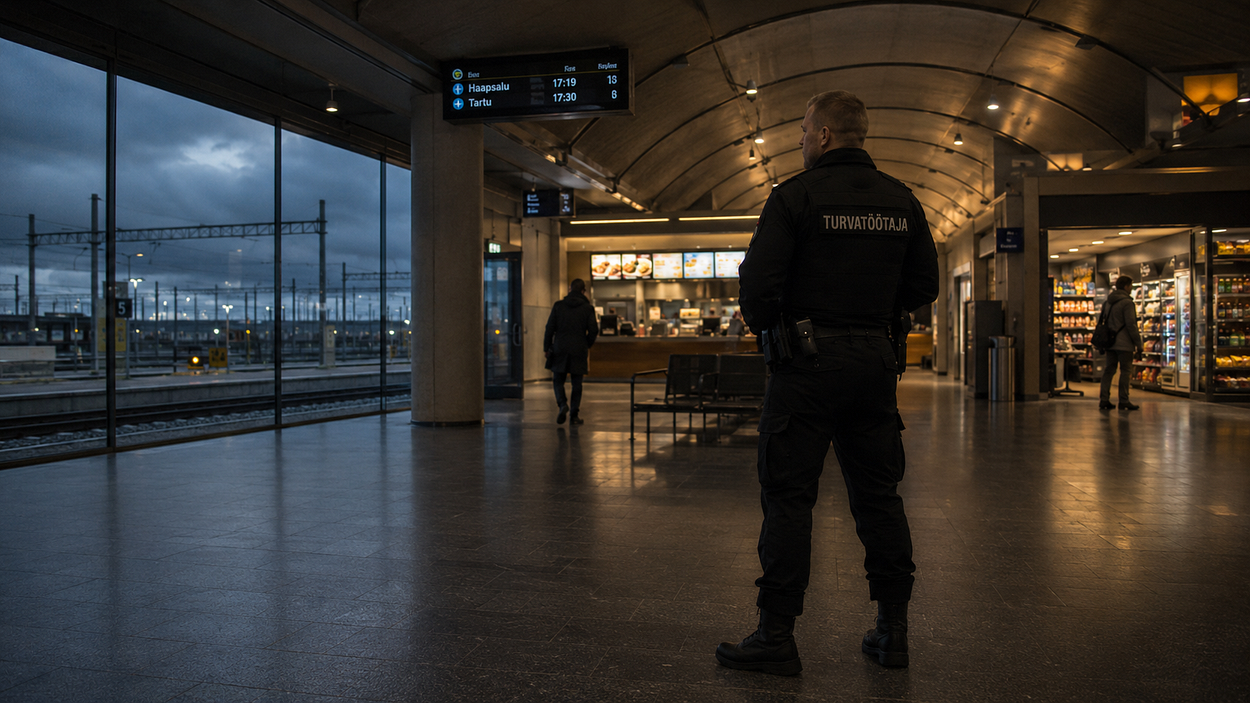
In the evening, on the way back through the city, I came across the main train station. A waiting hall given over almost entirely to a fast-food restaurant, a small supermarket, a food shop, and a ticket counter. And in the middle of it: a security guard. A person whose function, as far as I could tell, was simply to be visibly present. A human signal in a space that commerce had otherwise made entirely transactional. The oldest trust mechanism there is.
What X-Road actually is. And why it matters here
I'm in Tallinn because I'm accredited at Latitude59 next week. Estonia is the country that turned digital trust into a nationwide infrastructure project. The centerpiece of that project has a name most people outside tech-policy circles have never heard: X-Road.
The concept is easier to understand if you start with the problem it solves: Most countries that try to digitize their governments end up building a giant central database, one single place where all citizen data lives. That creates an obvious risk: one point of failure, one target for attack, one admin with too much power.
Estonia chose a different architecture: X-Road is not a database. It is a secure postal system between databases. Every public authority keeps its own data in its own systems, and X-Road lets those systems exchange information with each other: On request and with every transaction logged and timestamped.
The practical result: citizens only need to provide their data once. The "once-only principle" means the state doesn't ask twice for what it already knows.
- When you register a newborn, the health system, population register, and family benefits office coordinate automatically.
- When a police officer runs a check, they can query the health system or the business registry through a single interface.
- And crucially: every Estonian can log in and see exactly which institution has accessed their personal data, and for what purpose.
Transparency is not a side feature; it is the mechanism that makes trust possible.

The numbers are striking for a country of 1.4 million people: X-Road now connects over 900 institutions, powers more than 3,000 digital services, and has saved an estimated 2,589 working years of administrative time.
The model has since been adopted in Finland, Iceland, Japan and elsewhere. Linnar Viik, one of the architects of e-Estonia, captured the underlying paradox in an interview with the Christian Science Monitor:
The institution you can control and govern is your own government, but you don't trust? Why you don't trust your government who is under your control?
His point: people hand their data to Google, Facebook and others without hesitation, foreign companies accountable to no Estonian voter.
A contrast that stayed with me
A small aside that belongs somewhere in this piece: earlier in the day, I'd had a conversation about university enrollment procedures. The kind of administrative friction that tends to reveal a country's default assumptions about its citizens.
- In Germany, a sufficiently complicated enrollment case can, at escalation, still require a fax.
- In Estonia, the equivalent process is digital by default, with paper as the exception.
Both systems technically work. They embody completely different assumptions about who should bear the friction: the citizen or the institution.
The paradox of a single day
What I keep thinking about is not the X-Road. It's the gap between Estonia's reputation and a single day's worth of micro-decisions about trust.
The Palo Alto Club trusted me completely on arrival: chip in hand, name barely noted, no identity verified beyond. Airbnb, where I'm staying, built its entire business model on a comparable logic: the platform holds the funds in escrow, both sides perform their obligations, and the whole transaction rests. A way to make that kind of deal between complete strangers possible. The security guard at the station was doing something older and simpler: a body in a space, saying someone is paying attention here.
And then there is the Slack onboarding, which trusted nothing, and made me prove myself three times in fifteen minutes on the same device.
None of these are wrong individually. The 2FA is arguably correct for a shared communication tool. The chip handover makes sense in a professional community built on reputation. The Airbnb escrow is rational for a transaction between people who have never met. The security guard is doing something a camera cannot: embodying accountability. As one recent analysis of Estonia's digital society put it:
When interactions become overly automated, citizens may feel that vital human qualities - dialogue, empathy, recognition - are being replaced by speed.
Iivi Riivits-Arkonsuo at socialeurope.eu
What the day illustrated is that trust is not a single setting. It is a collection of micro-decisions, each calibrated differently, each producing a different texture of friction. Some friction is rational. Some is legacy. Some is a database that indexed the wrong entrance.
These are observations from one day, one person, one neighbourhood. Anecdote, not data, and I want to be clear about that. But sometimes a single afternoon surfaces more material than a week of structured research.
I'm here through Latitude59 next week, where I'll be looking at how the startup and tech ecosystem thinks about these questions. One more week after that, I'll be in Brno for Game Access, one of Europe's larger gamedev conferences. There I will ask game designers a version of the same thing: what happens in the moment when your system loses the person using it, and what does it take to earn them back?
Sources
X-Road: architecture, once-only principle, overview: https://e-estonia.com/solutions/interoperability-services/x-road/
X-Road: institutions, data exchange, citizen transparency: https://govinsider.asia/intl-en/article/estonias-x-road-data-exchange-in-the-worlds-most-digital-society
X-Road: 900+ institutions, 2,589 working years saved, international adoption: https://futureshiftlabs.com/x-road-technology-a-digital-backbone-of-estonias-cyber-security-and-dpi/
Once-only principle, proactive services (newborn example): https://journal.govcx.org/case-study-estonias-digital-transformation-journey/
Linnar Viik: "The institution you can control is your own government - but you don't trust?": https://www.csmonitor.com/World/Europe/2024/0402/Estonians-trust-their-government.-That-s-why-it-can-offer-advanced-services
Linnar Viik: "You earn trust through practice and execution": https://www.beesmart.city/en/smart-city-blog/estonia-smart-nation-on-the-baltic-sea
Linnar Viik: "Governments are losing the digital identities of their citizens to American companies": https://ideas.ted.com/where-in-the-world-will-you-find-the-most-advanced-e-government-estonia/
Iivi Riivits-Arkonsuo: "When interactions become overly automated, citizens may feel that vital human qualities - dialogue, empathy, recognition - are being replaced by speed": https://www.socialeurope.eu/estonias-digital-frontier-when-perfect-e-government-meets-the-paradox-of-trust