

Two decades of youth protection examined the product ever more closely, first the work, then the space around it. The people who help the person inside the game now work on fixed-term funding. A walk through Hall 10.
A short version of this essay appeared on Medium.
Gamescom 2026, Hall 10
Hall 10, Gamescom, Cologne, late August 2026. Between the large booths, small initiatives show their work. The Amadeu Antonio Foundation, a German civil-society organisation, advises players who experience digital violence and discrimination. At the stand of the federal office that administers the government's civil-society funding, a project shows how it trains community moderators. Flyers, workshops, counselling offers in between. The conversations here are about people: who reaches them, who attacks them, who helps them. In my talks nobody is speaking about game content.
Germany argued about banning violent games earlier and more publicly than most of Europe, which makes it a useful place to watch what became of that argument.
A self-experiment, mid-2000s
In the middle of the 2000s I was a freshly qualified education graduate with a focus on media, and Germany was fighting over "Killerspiele", literally killer games, the slogan of talk shows and party conferences. Judging a medium I knew only from television clips struck me as unserious. So I installed Tom Clancy's Rainbow Six 3: Raven Shield, a tactical shooter from 2003. I wanted to know what was supposed to be so terrible about this kind of game, and what it would do to me.
It did not go as planned. A few evenings turned into membership of a clan: fixed training times, agreements, people who asked where you were when you missed a session. We did not only train, we played in a league, with scheduled matches against other clans, fixtures, rules, promotion and relegation.
Wuppertal
Eventually a clan meeting came up. Nobody had to specify that we would actually meet in person; a meeting was a meeting. I travelled from Heidelberg to Wuppertal. Two or three of them picked me up at the station, the others waited at the meeting point, and there the first game of the weekend began: I was supposed to guess which person belonged to which player name.
I did terribly. And I knew these people. I knew their voices from the voice chat, and I knew exactly whom I could trust in a match: who, having promised to cover my back, really made sure nobody crept up behind me, and who instead went off to explore the map while I was shot from behind. None of that prepared me for the faces. I placed one person correctly, the only woman in the group.
An attempt to understand the effect of a "killer game" had turned into membership of a social structure. That was not a research design. It proves neither that shooters are harmless nor that gaming communities are dependable. But it moved my attention towards something the debate barely touched: the relationships that form while playing, and the question of who is there when they fail to hold.
Two decades later I meet that perspective again in Hall 10, now as the working brief of counselling services. The content question has not disappeared. Others have joined it. How is a game operated? What happens between the people inside it? And who can be reached when something goes wrong? The last of those has the most tentative answer.
When the slogan was meant to become law
The German "Killerspiel" debate had its loudest years between the school shootings of Erfurt in 2002, Emsdetten in 2006 and Winnenden in 2009. At its centre stood shooters, and the assumption that playing them could make adolescents aggressive, in extreme cases violent.
Two faces of one reaction
The political reaction had two very different faces. One was an inspection infrastructure. With the reform of the Youth Protection Act, the age ratings issued by the industry's own self-regulatory body, the USK, became binding for retailers in April 2003, having until then been purely informative [1]. That answered a different question from a ban: who may buy a game, not whether it may exist.
The other face appears in a bill introduced by the state of Bavaria in February 2007. It proposed a new section 131a of the criminal code, headed "Virtuelle Killerspiele" (virtual killer games), covering games that depict cruel or inhuman violence against humans or human-like beings and let the player take part in it. Distributing, publishing or producing them would have carried a fine or up to a year in prison; mere possession stayed unpunishable.
The reasoning is the remarkable part. Individual effects of violent games are still disputed, the draft concedes. In the next sentence it states that according to the current state of research there is no justified doubt about the danger of imitation and desensitisation. The argument about the evidence was written into the bill. It settled that argument by assertion [2].
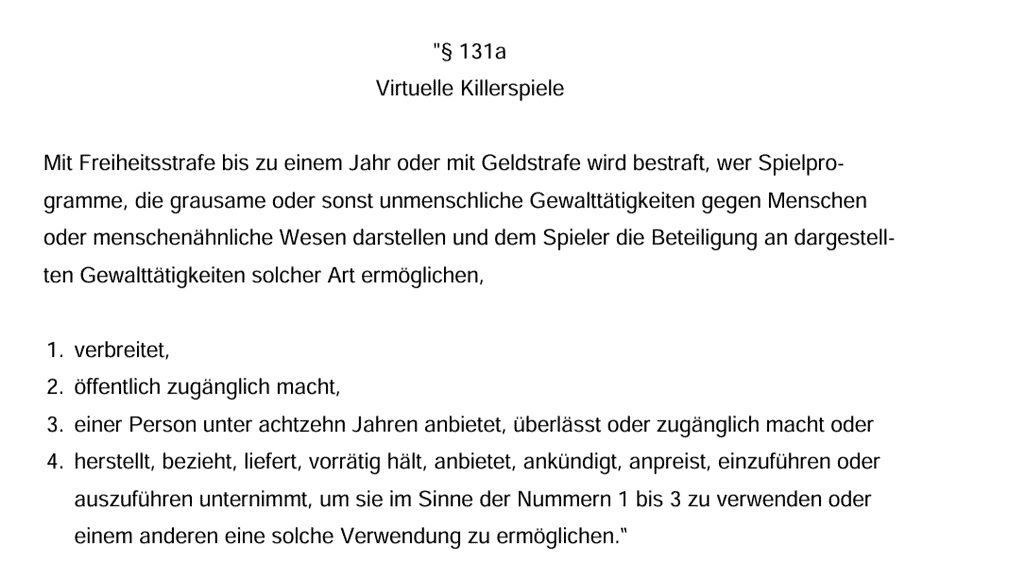
The offence never became law. The bill remains the document of how far the debate wanted to go: it aimed at the work, and it wanted to make a form of play a matter for criminal courts.
The industry pushed back
How visibly the industry pushed back I learn at Gamescom 2026, when Dieter Marchsreiter hands me a keepsake: a lanyard printed with "Spieleindustrie-Sympathisant", games industry sympathiser. He worked in industry communications at the time and was involved in the campaign; the story arrives later in writing. Olive-green T‑shirts went out alongside the lanyards to people working in media, he says, and were worn at fairs where industry, press and politics met. He can no longer date the object precisely and assumes 2009 onwards. Looking back, he suspects such a statement on your chest may have nudged conversation partners towards more careful wording. That cannot be proven. What is visible is that parts of the trade press openly sided with the medium under attack: they wore their allegiance on their bodies [3].
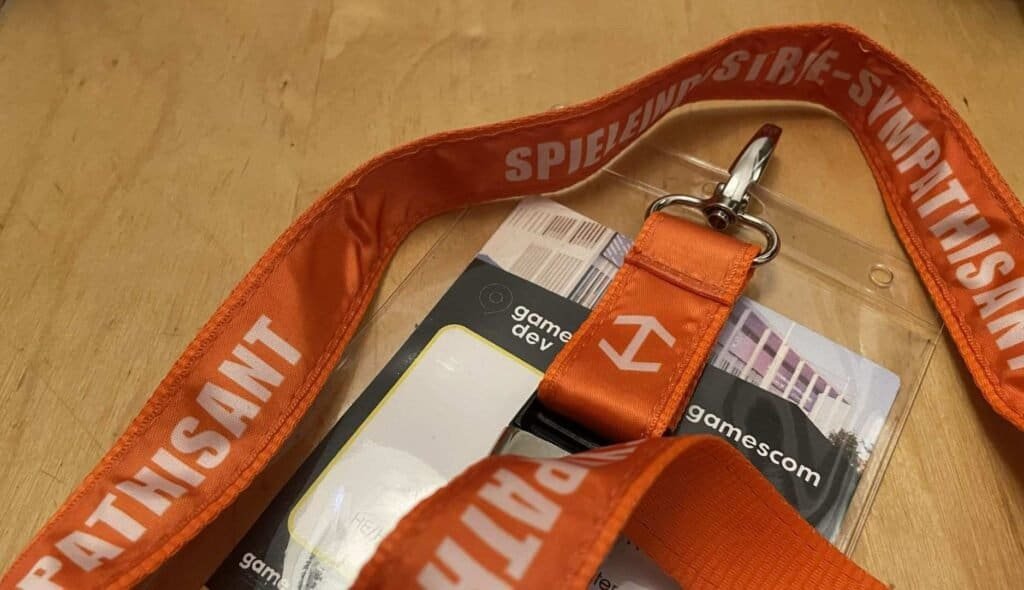
The band says what the fight was about: the work, and the right to sell it. The people in Hall 10 in 2026 are fighting about something else.
What research can say
The Bavarian bill invoked a state of research without justified doubt. What research has produced since is less an acquittal than a sorting exercise. A short-term reaction in a laboratory, aggressive behaviour in everyday life and serious violence are three different questions, and the answer looks different for each.
Two months of Grand Theft Auto
A team around Simone Kühn had adults play either Grand Theft Auto V or The Sims 3 daily for two months, with a third group playing nothing. Before and after, they measured more or less everything the debate had ever feared: aggression, empathy, impulsivity, mental health.
Of 208 statistical tests, three showed a shift in the feared direction, fewer than chance alone would have produced [4]. A strong finding, and a limited one. It holds for adults and for this design. It says nothing about children and adolescents, and the authors do not claim otherwise.
For adolescents there is a British study of just over a thousand fourteen- and fifteen-year-olds and their caregivers. It found no association between violent game use and the aggressive behaviour those caregivers reported. The method matters: hypotheses and analysis were registered publicly in advance, so nobody could compute a convenient result afterwards [5].
The fight over the summaries
Where many studies get summarised, the dispute continues. A 2018 meta-analysis found a small association over several years between violent game use and later physical aggression [6]. A 2020 analysis of longitudinal studies put the average association at around r = 0.06, shrinking further in the methodologically stronger studies [7]. That is a magnitude at which an association stays measurable while predicting almost nothing about an individual.
In 2025 a team around Craig Anderson recalculated the British data with a changed measurement approach and found an association again [8]. The argument is live, and by now it is partly an argument about which analysis is the right one.
What holds across the camps was formulated in 2020 by the American Psychological Association, which had once committed itself early. It maintained a small association with aggressive behaviours, shouting, shoving. It declared the evidence for a causal link to violent behaviour insufficient and warned against attributing mass shootings to violent games [9].
That distinction decides the old debate. A small association on a measure of aggression does not support the claim that a game turns people into mass shooters. Nor does it determine which regulation would be appropriate; that needs an argument about protective effect, depth of intervention and alternatives. Research has narrowed the strong claims of the ban years considerably. While the argument continued, what there was to argue about changed.
The box grows into a place
Raven Shield came on a disc. The packaging stood on a shelf, the game could be examined as a single title: play it through, then say what it shows. Even then that did not cover everything that happened while playing. My clan had servers, league fixtures and training times that were in no box. The social world was larger than the product.
In many of today's games the continuing operation is part of the offer: updates, rotating events, voice channels, contact functions and a shop that never closes. Where a game works that way, buying a work becomes access to a changeable space. It is less a book than a place. And a place carries different risks from a book.

That widens the questions. Who can make contact in there? How are conflicts handled? How transparent are the costs? How easy is it to stop?
Roblox
Roblox shows why the appearance of a service is a poor guide. The platform looks like the opposite of a killer game, colourful blocks, no orgies of violence. It contains very different games made by its users, and a friendly surface says nothing about which messages people can send each other inside it.
A preprint published in May 2026 examined around two million chat messages from four Roblox games and documented what moderation let through: sexualising remarks, harassment, content related to grooming. The work is not peer reviewed and supports no statement about Roblox experiences in general. It does show concrete gaps in a protection system within the chats examined [10].
Four questions instead of one
Worth pausing here, because the old debate and the current one are easily confused. With the question of whether violent content makes people aggressive, an effect has to be demonstrated, and researchers have argued about that for twenty years. With a documented threat in a chat, that causal question does not arise. The message is already the act against another person.
Two different evidentiary questions, and two more behind them. How often do such acts occur, and which platform functions make them easier? And, separately from that, which measures help? Each of the four can be well or poorly supported, and each fails in its own way. Put all four in one sentence and you end up either alarmist or dismissive, depending on which one is currently the thinnest.
The shop and the return visit
A second change lies in the business model. With paid loot boxes you pay for a random selection of virtual items; what you get is not determined at purchase. Loot boxes share a structural feature with slot machines: chance decides the outcome, and no skill does.
Research finds an association between higher loot box spending and more pronounced gambling problems; a 2021 meta-analysis summarised the findings. What does not follow is the direction: whether loot boxes cause problems, whether they particularly attract vulnerable people, or whether both interact [11]. It matters for youth protection regardless. A business model can generate high spending precisely among people who struggle to control it. For the age rating as the old debate knew it, that was not a criterion.
Come back tomorrow
Alongside it sits the design of the return visit: daily rewards that expire if you miss a day, time-limited offers, secondary currencies whose exchange rates obscure the overview. Under the term predatory monetization, researchers describe purchase models whose true cost becomes visible only once players have already invested time, money or attachment [12]. That is an analysis of mechanisms, not proof that each function has the same effect on every person. The design is well described, its effect barely proven.
Playing a lot is not a diagnosis
The World Health Organization describes gaming disorder through impaired control, increasing priority given to gaming and continuation despite negative consequences; substantial impairment of important areas of life must be present as well, normally over at least twelve months [13].
That leaves a double task: take distress seriously, and avoid pathologising enthusiasm too quickly. Both require looking at the specific person. The age label can support that look. It cannot replace it.
Youth protection widens its view
Section 10b
The widening can be read in the statute. Since the 2021 reform, section 10b of the Youth Protection Act explicitly takes into account risks outside the immediate content: "risks through communication and contact functions, through purchasing functions, through gambling-like mechanisms, through mechanisms promoting excessive media use". That is, almost word for word, the list from the two previous chapters. The law ties their consideration to preconditions and to a concrete risk assessment; there is no fixed weighting between content and use [14].
This has had practical consequences since January 2023, when the ratings body adjusted its examination rules. For 2023 it reported that around 30 percent of examined games with online functions received a higher age rating because of such usage risks, not because of what appears on screen [15]. A rating says more than it used to. It is still no guarantee for every encounter inside a game, and the body does not claim it is.
Authorities and Europe
The federal centre for the protection of children and young people in the media, created in 2021 out of the older federal review office, deals with structural questions of protection, with providers' precautionary measures and with risks from contact and communication [16]. Its review unit still runs indexing procedures, so titles are still placed on a restricted-distribution list [17].
At European level, the Digital Services Act requires online platforms accessible to minors to take appropriate and proportionate measures for their privacy, safety and security, generally since February 2024 and earlier for very large services, with exemptions for the smallest firms. It also governs illegal content, so it is no turning away from content. Its approach is different from a review body's: no prior examination of each individual game, but responsibility of the services for their own procedures [18]. This part of the picture applies across the European Union, not only in Germany.
The old content question was not abolished; the mandate has become broader. And anyone talking about how a game is operated sooner or later reaches the question of who can be reached inside it.
Who works in these spaces
In Hall 10 the broader mandate acquires faces and project names. Good Gaming Support, the counselling service of the Amadeu Antonio Foundation, is aimed at people who experience hate, discrimination or digital violence in gaming, and it supports education professionals and people who build communities [19]. Nearby, the federal office that implements the government programme "Demokratie leben!" (Live Democracy) hosts the projects it funds, among them Press Start, which does civic education with adult players on Twitch and Discord, and the Community Support Network of the Foundation for Digital Games Culture, a subsidiary of the industry association, which trains community managers and moderation teams in conflict handling, community rules and self-care [20].
From the margin to the centre
The perspective is not new. As early as 2006 the JFF, a German institute for media education research, surveyed adolescents at the Games Convention in Leipzig about their playing habits [21]. Approaches that looked at usage and social context had existed for a long time. They simply did not shape the political picture, which was about content, age ratings and assumptions about effects.
What has changed is the position of that perspective: it has moved from the margin to the centre. A few aisles further on, the ratings body explains to parents how age labels and protection settings work. The initiatives here do something else. They advise, moderate, train, accompany. Their material is contact, communication and group dynamics, exactly the operational features the law has recognised since 2021.
The everyday case in this field is neither recruitment nor abuse but the climate itself: insults, hate, harassment among players. How communities tip and what moderation can do about it I have described elsewhere; the short version is that ban hammers alone heal little, and the conditions of the space decide more than the character of individuals [22].
What happens after the click on "report"
What distinguishes this work from examination is the moment it starts. Moderating a community takes more than a list of forbidden words. It means assessing a conflict, enforcing limits, recognising where your own capacity ends. An affected person may need an explanation, support with the next step, or a referral onwards.
This combines with legal obligations and technical safeguards; it does not replace them. A reporting route can create the contact to help, and a safe default can prevent the distressing encounter entirely. And still the question remains what happens after the click on "report", and whether the answer fits the situation.
The existence of a workshop does not establish its effectiveness, and counselling services must be measured by whom they reach and where their limits lie. But uncertainty about the best measure is something other than uncertainty about whether an assault took place. Concrete help does not have to wait until research has determined the influence of every platform function.
Help with an expiry date
How dependable this work is depends on how it is financed. In June 2026 the federal government answered a parliamentary question about Good Gaming Support by stating that the project, like the other innovation projects and the projects of a further programme strand, ends at the close of 2026, and that existing organisations could apply for future funding with new proposals [23]. The answer describes a further development of the programme. It does not guarantee the continuation of this particular service.
That proves neither the end of all help in gaming nor a rejection of the organisation behind it. It makes something structural visible: an existing service cannot plan its continuation on the grounds that the need continues. Project funding has its purpose. It creates room for new approaches and forces a decision about which of them should stay. But when a service is already advising people and supporting moderation teams, its ending raises the question of who takes over the ongoing contacts, where the knowledge goes, and who people get referred to next.
What is permanent and what runs out
The old debate left authorities with a statutory mandate: a review body, binding age labels, since 2021 a federal centre with expanded tasks. Examination of the product is permanently institutionalised, with budget lines and paragraphs. Accompanying the people inside the product runs on grant decisions with an end date.
The contrast is not complete. Platform protection has a statutory mandate too, and human support exists in many structures, from school social work to youth counselling. But at the spot this text visited, the distribution is unambiguous. What examines the work stays. What accompanies the person runs out and reapplies. The end of a budget year does not end a conflict on a Discord server.
What remains after the examination
In Wuppertal I sat as an adult among people who knew each other without ever having met. We had played together, trained together, looked out for each other. The structure that held me had been built by us, and it held as long as those people stayed.
I would not retrospectively declare that clan an educational programme. We were not a counselling service, and my good experience says nothing about how safe other groups were. But I remember how much depended on certain people being there and taking responsibility for each other.
A person alongside
Two debates have since examined the product, first the work, then the space. Both were necessary, and both got their institutions. What stayed at the margin of both is the moment when all the examinations have long been passed and something goes wrong anyway: a child, late at night, alone in front of a screen, in a situation they cannot make sense of. Someone has written something that should not have arrived. Or the game has long since ended and the head is still in it.
The age label on the packaging is correct. The defaults were set properly. The report button is there, and perhaps it gets pressed. The question is who answers afterwards, and whether anyone does at that hour.
No rating is responsible for that moment, and no default setting. A person would be. As an educator I am convinced that such moments call for exactly that: not another filter, but someone alongside. That is a position, not a finding. But it explains why I stood longer at the small booths in Hall 10 than at the big ones.
At Gamescom that responsibility now appears as organised work at the end of a chain. Good system design should ensure that as few situations as possible require a person at all. After that come reporting routes and moderation. Only behind them begins the work that makes sense of a situation, accompanies it or refers it onwards. In Hall 10 that last link was the least secured.
No simple story follows from this, in which the old worry was wrong and the new one right. What follows is one in which the view has become more precise: of content, of business models, of encounters, and of the conditions under which people find support.
A game can be examined. An operator can have rules. A report button can work. Whether someone in a distressing situation actually feels held depends on who answers next and what that person is able to do.
Back then I was lucky with the people in my clan. Reliable youth protection should help make sure that help depends less on luck.
Sources (open if needed)
[1] Internet-ABC (2023): Digitale Spiele und Kinder: USK-Altersfreigaben und Sicherheitstipps. German media literacy portal; interview with Lorenzo von Petersdorff, deputy managing director of the USK, 10 November 2023, on age ratings becoming binding for retail in April 2003. https://www.internet-abc.de/eltern/gewalt-spiele-videos-wirkung-auf-kinder/digitale-spiele-und-kinder-usk-altersfreigaben-und-sicherheitstipps/
[2] Freistaat Bayern / Bundesrat (2007): Entwurf eines Gesetzes zur Verbesserung des Jugendschutzes (JuSchVerbG). Bill introduced by the state of Bavaria in the German Bundesrat, document 76⁄07 of 2 February 2007, containing the proposed section 131a of the criminal code, "Virtuelle Killerspiele"; never enacted. https://www.bundesrat.de/drs.html?id=76-07
[3] Marchsreiter, Dieter: Written communications to the author via LinkedIn, not publicly accessible. Information on the distribution of lanyards and olive-green T‑shirts to media professionals, on their being worn at trade fairs, and on the approximate dating from 2009 onwards. The suspected effect on conversation partners is a personal retrospective assessment.
[4] Kühn, S.; Kugler, D. T.; Schmalen, K.; Weichenberger, M.; Witt, C.; Gallinat, J. (2019): Does playing violent video games cause aggression? A longitudinal intervention study. Molecular Psychiatry 24, 1220-1234. Intervention study with adults. https://doi.org/10.1038/s41380-018‑0031‑7
[5] Przybylski, A. K.; Weinstein, N. (2019): Violent video game engagement is not associated with adolescents' aggressive behaviour: evidence from a registered report. Royal Society Open Science 6(2), 171474. https://doi.org/10.1098/rsos.171474
[6] Prescott, A. T.; Sargent, J. D.; Hull, J. G. (2018): Metaanalysis of the relationship between violent video game play and physical aggression over time. Proceedings of the National Academy of Sciences 115(40), 9882-9888. https://doi.org/10.1073/pnas.1611617114
[7] Drummond, A.; Sauer, J. D.; Ferguson, C. J. (2020): Do longitudinal studies support long-term relationships between aggressive game play and youth aggressive behaviour? A meta-analytic examination. Royal Society Open Science 7(7), 200373. https://doi.org/10.1098/rsos.200373
[8] Miles-Novelo, A.; Anderson, C. A. (2025): The Question of Violent Video Games and Aggression: Testing Statistical and Methodological Issues of Null Effects Using Data From an Open-Access Case Study. Aggressive Behavior 51(4), e70042. Reanalysis of the data from Przybylski and Weinstein (2019). https://doi.org/10.1002/ab.70042
[9] American Psychological Association (2020): APA reaffirms position on violent video games and violent behavior. Press release of 3 March 2020 on the updated Resolution on Violent Video Games. https://www.apa.org/news/press/releases/2020/03/violent-video-games-behavior · https://www.apa.org/about/policy/resolution-violent-video-games.pdf
[10] Kaushik, P.; Brown, S.; Hasan, R.; Rahaman, S. (2026): An Evaluation of Chat Safety Moderations in Roblox. arXiv:2605.04491, May 2026. Preprint, not peer reviewed; examination of chat messages from four Roblox games. https://arxiv.org/abs/2605.04491
[11] Garea, S. S.; Drummond, A.; Sauer, J. D.; Hall, L. C.; Williams, M. N. (2021): Meta-analysis of the relationship between problem gambling, excessive gaming and loot box spending. International Gambling Studies 21(3), 460-479. https://doi.org/10.1080/14459795.2021.1914705
[12] King, D. L.; Delfabbro, P. H. (2018): Predatory monetization schemes in video games (e.g. 'loot boxes') and internet gaming disorder. Addiction 113(11), 1967-1969. Editorial; not an experimental effect study. https://doi.org/10.1111/add.14286
[13] World Health Organization: Gaming disorder. Explanatory notes on ICD-11. https://www.who.int/standards/classifications/frequently-asked-questions/gaming-disorder
[14] Federal Republic of Germany: Jugendschutzgesetz, § 10b: Entwicklungsbeeinträchtigende Medien. German Youth Protection Act, section on media likely to impair development; in particular subsections 2 and 3 on the consideration of usage risks. https://www.gesetze-im-internet.de/juschg/__10b.html
[15] Unterhaltungssoftware Selbstkontrolle (USK) (2024): USK-Jahresstatistik 2023. Annual statistics of the German self-regulatory games rating body, including the figure of around 30 percent of examined games with online functions receiving higher age ratings because of usage risks. https://usk.de/usk-jahresstatistik-2023/
[16] Bundeszentrale für Kinder- und Jugendmedienschutz (BzKJ): Aufgaben. Overview of the tasks of the German federal centre for the protection of children and young people in the media, including the expanded statutory mandate and the continuation of its review unit. https://www.bzkj.de/bzkj/ueberuns/aufgaben
[17] Bundeszentrale für Kinder- und Jugendmedienschutz (BzKJ): Wie läuft ein Indizierungsverfahren ab? Description of the German indexing procedure for media harmful to minors. https://www.bzkj.de/bzkj/indizierung/wie-laeuft-ein-indizierungsverfahren-ab/wie-laeuft-ein-indizierungsverfahren-ab-175550
[18] European Parliament and Council (2022): Regulation (EU) 2022⁄2065 of 19 October 2022 on a Single Market For Digital Services (Digital Services Act). In particular Articles 16, 19, 28, 92 and 93. https://eur-lex.europa.eu/legal-content/EN/TXT/?uri=CELEX:32022R2065
[19] Amadeu Antonio Stiftung (2026): Good Gaming Support: Neues Beratungsangebot für Betroffene von Hass im Gaming. Announcement of the counselling service by the German foundation running it, 19 May 2026. Provider's own account. https://www.amadeu-antonio-stiftung.de/good-gaming-support-neues-beratungsangebot-fuer-betroffene-von-hass-im-gaming-165943/
[20] Stiftung Digitale Spielekultur: Community Support Network. Project description by the German Foundation for Digital Games Culture, covering management and care structures for resilient gaming communities, including funding details. Provider's own account. https://www.stiftung-digitale-spielekultur.de/project/community-support-network/
[21] JFF - Institut für Medienpädagogik in Forschung und Praxis (2007): Voll verspielt und gut gebildet. Survey of adolescents at the Games Convention 2006, published by a German institute for media education research. Munich.
[22] Burghard, Björn (2026): Toxic Behavior in Online Games: What Actually Helps. Waycleft, 3 March 2026. https://waycleft.com/toxic-behavior-in-online-games-what-actually-helps/
[23] Deutscher Bundestag / Bundesregierung (2026): Schriftliche Fragen mit den in der Woche vom 22. Juni 2026 eingegangenen Antworten der Bundesregierung. Written questions to the German federal government and its answers, Bundestag document 21⁄6731 of 26 June 2026, answer to question 61, on the ending of Good Gaming Support and further programme strands at the close of 2026 and on the possibility of reapplying. https://dserver.bundestag.de/btd/21/067/2106731.pdf
Personal experiences and observations at the trade fair are the author's own. Providers' self-descriptions and the preprint that has not been peer reviewed are marked as such. AI-generated images are identified in the images.